UNGA-I: New Data on the UN General Assembly
Bridget Coggins, Jungjae Hong, Julia C. Morse, and Annjulie Vester
Cite: Coggins, Bridget, Hong, Jungjae, Morse, Julia C. and Vester, Annjulie. Forthcoming. “Introducing UNGAInsight (1990--2023): New Data on the United Nations General Assembly's Agenda.” Journal of Peace Research.
Abstract: Scholars use roll-call voting in the United Nations General Assembly to understand various political phenomena. Yet information on the politics of voting is limited because scholars lack details on the content and context of resolutions. This article fills this gap by providing new data: UNGAInsight (UNGA-I). UNGA-I complements existing datasets with new data on resolutions from 1990 to 2023, offering 32 mutually exclusive substantive topic categories that map onto the organization's own committee-centered workflow. UNGA-I also includes information on which countries are targeted by specific resolutions and the nature of related demands. Finally, it provides more detailed information on the political dynamics that undergird absences. The data will allow researchers to develop more nuanced understandings of the UN and its political relevance across time. Additional insight into the UNGA's agenda also raises questions about the common practice of using UN voting patterns as an indicator of alignment with the US-led liberal international order.
New Data on Resolution Content
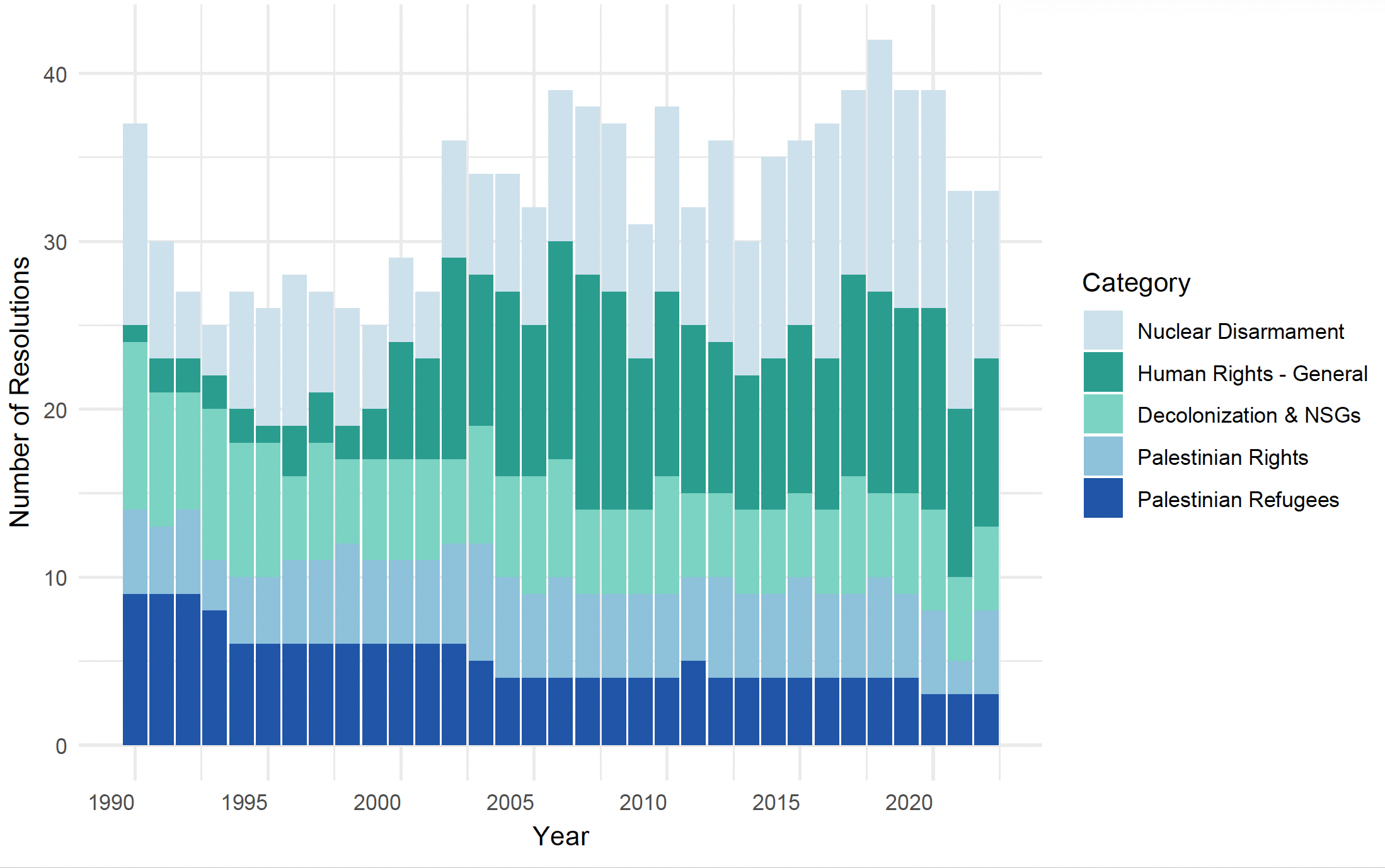
UNGA-I provides new information on resolution content, breaking down UNGA resolutions into 32 mutually exclusive substantive topic categories and identifying their originating UN committee. Placing each resolution into a primary topic area reveals how the UNGA's agenda and political stakes have shifted over time. Substantive categories such as the environment, outer space, and the law of the sea permit subject-matter-specific analyses that may be more relevant to scholars' primary topics of inquiry.
New Data on Resolution Targets
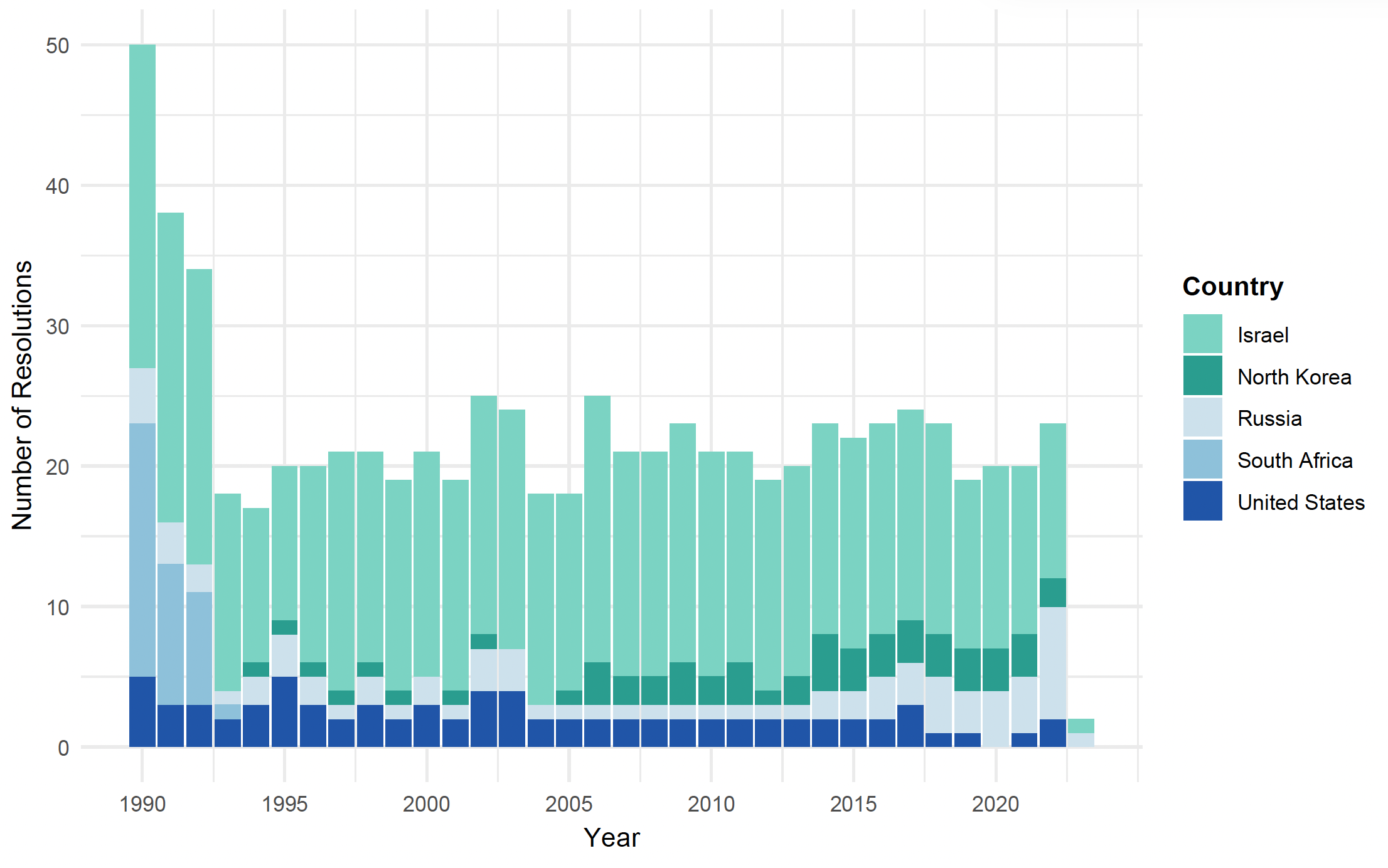
UNGA-I also provides new information on the geopolitics of resolutions, identifying each resolution's country targets. Between 1990 and 2023, the UNGA adopted resolutions that made demands of 30 countries. Although most of those resolutions targeted Israel, other countries including the United States, Russia, and North Korea were also frequent targets. Other targets included states of the former Yugoslavia and Sudan, in resolutions addressing threats to international peace and humanitarian concerns.
New Data on Absences
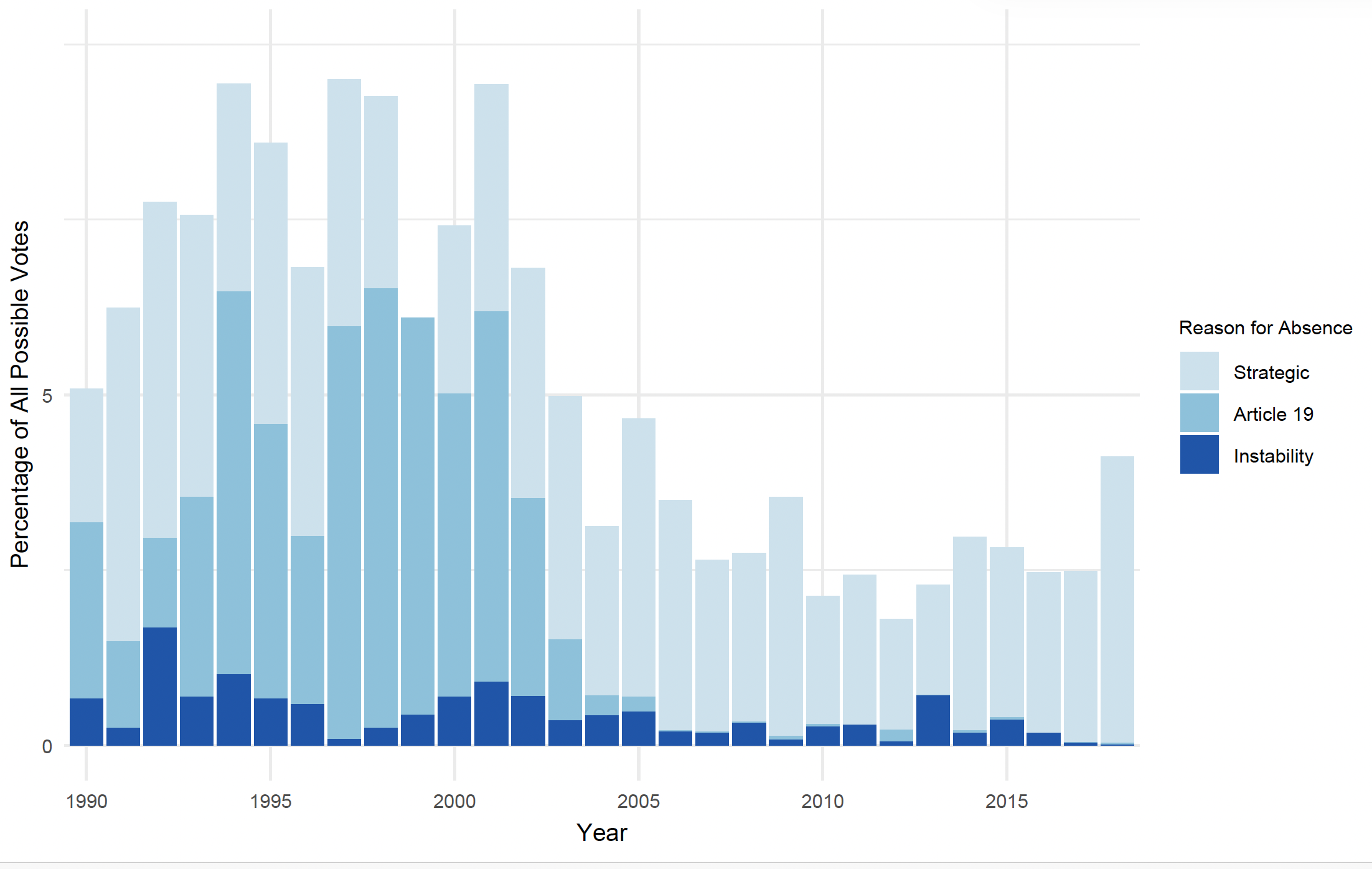
UNGA-I sheds light on the political motives that may undergird absences, which account for nearly ten percent of possible roll-call votes. Data on explained absences reveal that, particularly in the 1990s and early 2000s, many states were absent because they lost their voting rights, a sanction for being in arrears of their dues. Other delegations are chronically absent due to instability, external occupation, or government collapse at home. Still other states are periodically absent for strategic reasons, preferring not to register a vote.